
WHAT YOU NEED TO KNOW
To properly understand the rules of Blackjack, players must master basic card values, dealer constraints, and when to hit or stand to reduce the house edge.
- Card values: Number cards represent their face value, face cards are worth 10, and Aces count as 1 or 11.
- The main objective: You must beat the dealer’s hand total without going over 21.
- House edge baseline: Standard games feature a low house edge of approximately 0.5% when using basic strategy, as verified by eCOGRA audit data in 2026.
- Dealer rules: Dealers are bound by fixed rules, usually forcing them to hit on soft 17 or stand on all 17s.
Your success depends on applying optimal decision-making to every hand rather than relying on luck or gut feelings.
How to Understand the Rules of Blackjack and Its Core Objective
Many beginners believe the main goal is simply to get as close to 21 as possible. The real goal is to beat the dealer’s hand without exceeding 21. If your hand total is higher than the dealer’s, or if the dealer busts, you win.
If your hand exceeds 21, you bust immediately and lose your bet, even if the dealer subsequently busts. This fundamental rule gives the casino its inherent house advantage. Understanding this dynamic is the first step to successful play.
What Are the Blackjack Card Values?
To calculate your hand total, you must know the value of each card in the deck. Suits do not matter in standard blackjack, only the numerical value of the cards. Cards from two through 10 carry their face value.
Face cards, which include the Jack, Queen, and King, are worth exactly 10 points each. Aces are the most powerful cards because they are highly flexible. An Ace can count as either one or 11 points, depending on what benefits your hand more.
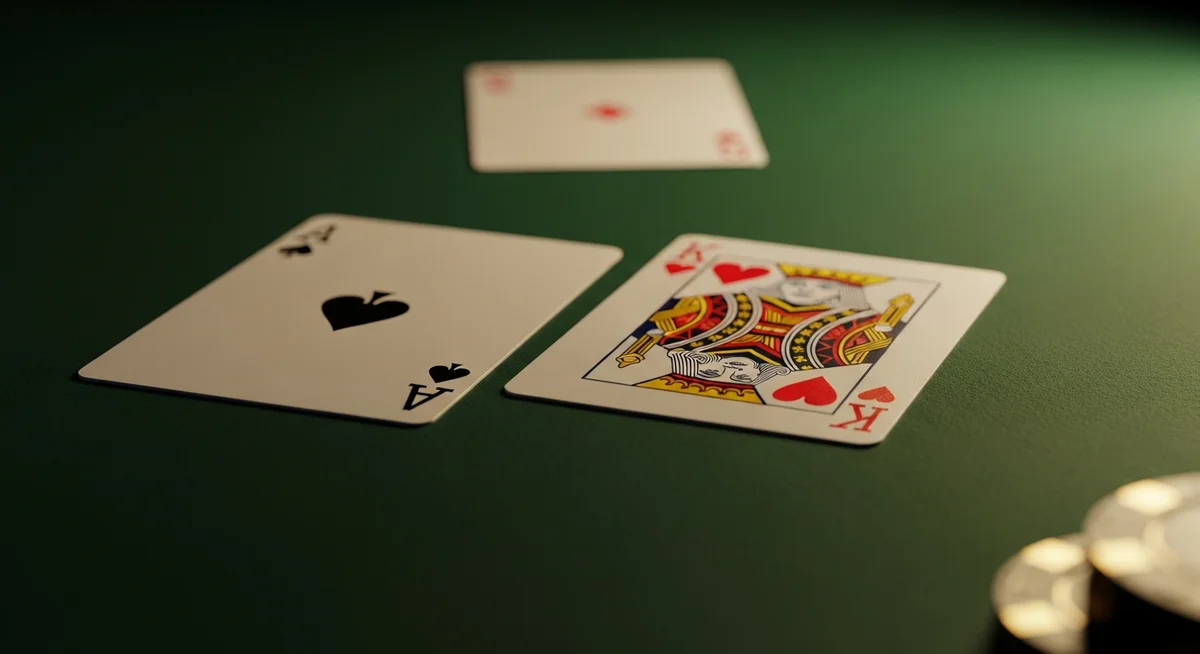
A hand containing an Ace valued at 11 is called a soft hand because it cannot bust if you take another card. For example, an Ace and a six make a soft 17. If you draw a nine, the Ace automatically converts to a value of one, turning your hand into a hard 16.
| Card Type | Value | Soft/Hard Hand Status |
|---|---|---|
| 2 through 10 | Face value (2 to 10) | Hard hand |
| Jack, Queen, King | 10 points | Hard hand |
| Ace | 1 or 11 points | Soft hand (if valued at 11) |
Step-by-Step: How is a Blackjack Round Played?
Every round follows a structured sequence at both retail and online tables. First, players place their chips in the betting circle. For American players, verifying where online gambling is legal in the US is crucial before choosing a real-money platform.
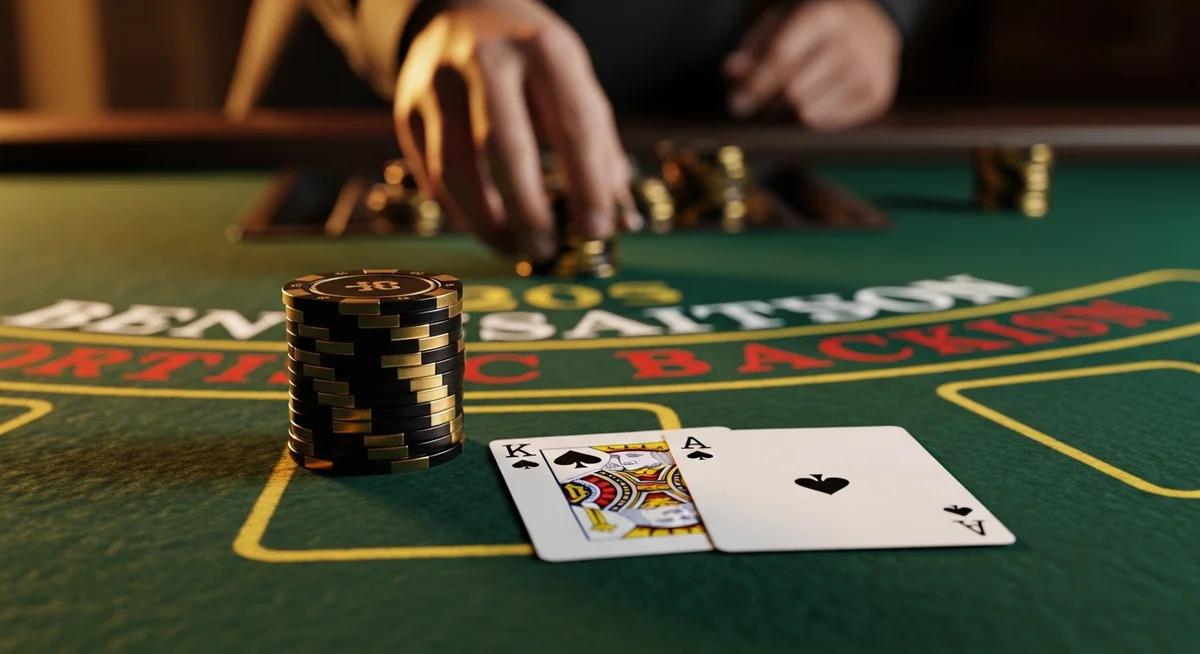
Once bets are placed, the dealer distributes two cards to each player, face up. The dealer also receives two cards, but only one is face up, while the other remains face down. After checking for an immediate player blackjack, the action moves clockwise around the table.
Each player decides how to play their hand based on the dealer’s visible card. Once all players have completed their actions, the dealer reveals the face-down card and completes their hand according to set rules.
Player Decisions: What Are Your Options During a Hand?
Unlike slots, which rely purely on random number generators as detailed in our guide explaining how slot machine algorithms work, blackjack involves active player decisions that directly influence the house edge. You have several distinct choices once your initial cards are dealt. These options form the basis of all tactical play.
When Do You Hit and Stand?
To hit means to request another card from the dealer to increase your point total. You can hit as many times as you want, provided your total does not exceed 21. To stand means to keep your current hand and end your turn.
You should generally stand when you have a hard hand of 17 or higher, as the risk of busting is extremely high. If your hand is 11 or lower, you should almost always hit, as you cannot bust with a single card.
What Is Doubling Down?
Doubling down allows you to double your original wager in exchange for committing to stand after receiving exactly one more card. This is a powerful option when the dealer is showing a weak upcard, such as a five or six. Most strategies recommend doubling down when your hand total is 10 or 11, as you have a high chance of hitting a 10-value card to reach 20 or 21.
Keep in mind that you cannot hit again after doubling, even if you draw a low card like a two. This limitation makes the decision highly dependent on the dealer’s visible card.
When Should You Split Pairs?
If you are dealt two cards of identical value, you can split them into two separate hands. This action requires you to place a second wager equal to your original bet. The dealer separates the cards and deals a second card to each one, allowing you to play them as two independent hands.
You should always split Aces and eights. Splitting Aces gives you two chances to hit 21, while splitting eights breaks up a highly disadvantageous hard 16. Never split 10-value cards or fives, as a 20 is already an excellent hand, and two fives are better played as a hard 10.
How Do Insurance and Surrender Work?
Insurance is a side bet offered when the dealer’s upcard is an Ace. It costs half your original wager and pays 2 to 1 if the dealer has blackjack. According to regulatory reviews by the Malta Gaming Authority (MGA) in 2026, insurance is mathematically a poor bet for players because the dealer has blackjack only about 30% of the time.
Surrender is a rule allowed at some tables where you can forfeit your hand and lose half your bet. This option is best used when you hold a hard 15 or 16 and the dealer shows a strong nine, 10, or Ace.
What Are the Dealer’s Rules for Hitting and Standing on 17?
While players enjoy complete freedom in how they play, the dealer is bound by strict, unalterable house rules. The dealer has no strategic choices to make. At most tables, the dealer must hit on any hand total under 17 and must stand on any total of 17 or more.
However, the specific rule regarding a soft 17 varies by table. A table labeled H17 (Hit Soft 17) increases the casino’s house edge by roughly 0.2% compared to an S17 (Stand on Soft 17) table. This rule is always printed clearly on the felt of the table.
| Dealer Rule Type | Dealer Action on Hard 17 | Dealer Action on Soft 17 | Impact on House Edge |
|---|---|---|---|
| Stand on All 17s (S17) | Stand | Stand | Favorable to Player (Baseline) |
| Hit Soft 17 (H17) | Stand | Hit | Increases House Edge by ~0.2% |
What Are the Different Hand Outcomes and Payouts?
The payout you receive depends entirely on how you win the hand. If your hand is closer to 21 than the dealer’s, you win an even-money payout of 1 to 1. If you hit a natural blackjack on your first two cards, the standard payout is 3 to 2.
Some tables offer a reduced payout of 6 to 5 for blackjack. Data published by the UK Gambling Commission (UKGC) highlights that 6 to 5 tables significantly increase the house edge, so players should avoid them whenever possible. If your hand total matches the dealer’s total, the result is a push, meaning your wager is returned to you.
| Hand Outcome | Winning Condition | Standard Payout Rate |
|---|---|---|
| Standard Win | Player total higher than dealer, or dealer busts | 1 to 1 (Even Money) |
| Natural Blackjack | Ace and 10-value card on initial deal | 3 to 2 (Avoid 6 to 5 tables) |
| Insurance Win | Dealer has blackjack (side bet only) | 2 to 1 |
| Push | Player total equals dealer total | Stake Returned (No payout) |